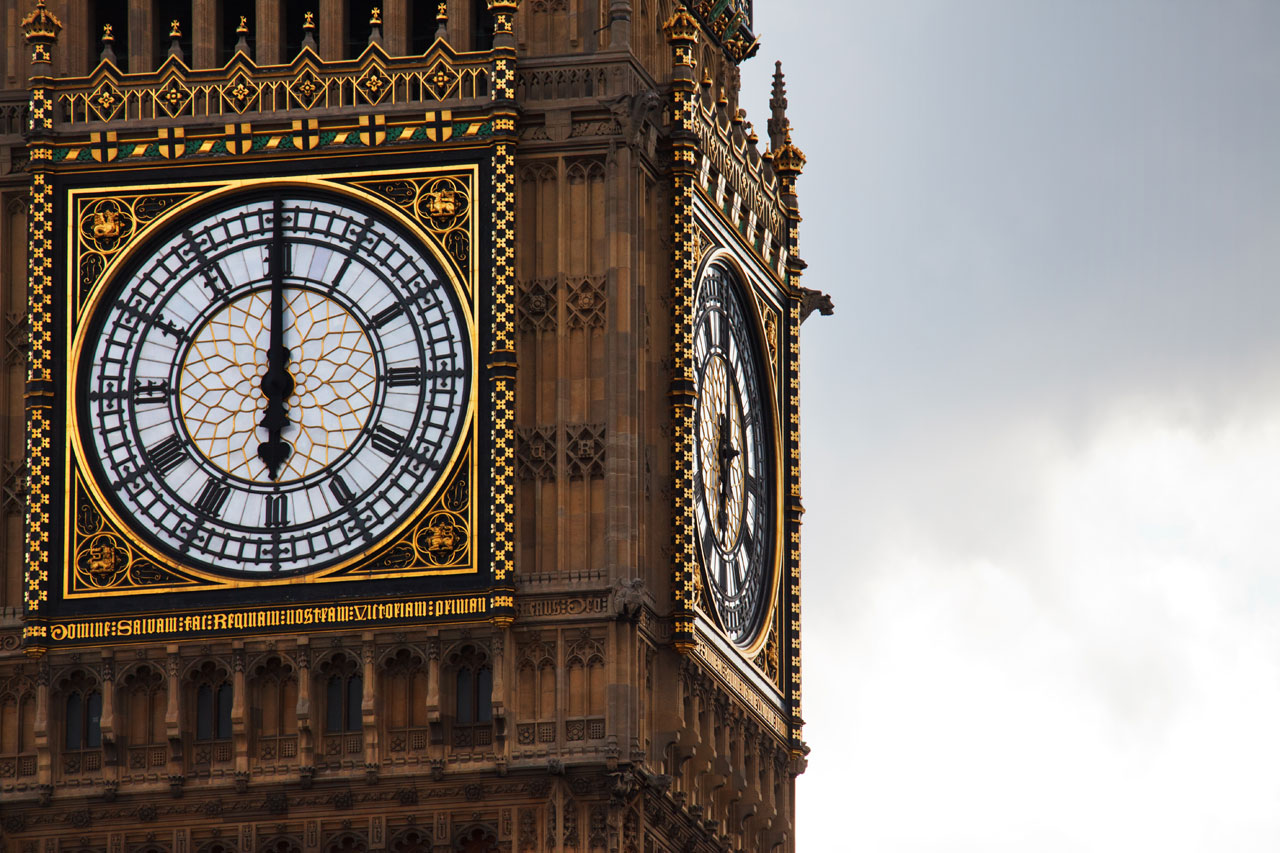
Today, on this last Sunday of 2025, I’m reflecting on the concept of time. We live in a strange tension with time, both because we have seemingly a very finite amount of it, and yet, because we are eternal beings, we have an unlimited quantity. The thought of how finite our time is here usually wins.
I so often feel I don’t have enough time, and it seems like it’s true, as in, I’m late publishing this post. Holidays sometimes feel like a series of deadlines to be met, which often leaves us unable to enjoy them as we’d like.
As the year draws toward its close, I especially find myself interspective. God has given me time. He gave me a 2nd chance when, in 2004, I was diagnosed with cancer. It nearly killed me. I pray I’ve used the chance He gave me wisely. Even more, I hope He thinks I have. I also look ahead to 2026 and wonder what the future holds.
I find two verses from scripture comforting.
Psalm 31:15 – “My times are in your hands;
and
Jeremiah 29:11 – “For I know the plans I have for you,” declares the LORD, “plans to prosper you and not to harm you, plans to give you hope and a future.”
So I extend to you, dear reader, my sincerest wishes for a joyous, prosperous, and healthy 2026. May you straddle the tention between our finite lives here and our eternal lifes in the spirit successfully. And may your life glorify your Creator.
Today, this 4th and last Sunday of Advent, I’m thankful for the blessing of love. The below story is inspired by a birthday card my husband sent me once, asking me what the creation was like lol. It’s a reimagining of the fall of the angels that eventually put into motion the downfall of humans as well.
1 In the beginning was the Word, and the Word was with God, and the Word was God.
2 He was with God in the beginning.
3 Through him all things were made; without him nothing was made that has been made.
4 In him was life, and that life was the light of all mankind.
5 The light shines in the darkness, and the darkness has not overcome it.
Lights. They were everywhere. Nothing impeded their brightness. They danced from one end of the heavens to the other. Planets, stars, suns, moons–all gave off or reflected light. Some faded out, others glided in, but always and everywhere there were lights, and there was light, and nothing was known of darkness in the great vaults of heaven. Even a great master angel bore the name of bearer of light, for he was the brightest of them all.
“Why can’t I be equal to God? Why can’t I be as bright?” The thought was fleeting, but in that time it took the thought to form, so did a little darkness. The thought passed quickly. Yet still it began to haunt this angelic light-bearer. And the more it did, the more darkness began to obscure the once ever-shining light.
And so it was, at a fateful time to long ago to count, that the Great God, 3 in 1, Father, Son, & Holy Spirit, discerned the cause of this darkness and decided to call a meeting with this angel.
A sound was heard throughout heaven. It was the voice of God, summoning the Light-Bearer into the great meeting hall. The sound was low and soft, akin to what those on earth many eons later would liken to a distant thunderstorm, nonthreatening, yet somehow ominous, soft, yet filling the entire heavens, gentle, but with the unmistakeable potential for threat lurking within. The light-bearer heard it, and for the first time felt a strange and unfamiliar enmity toward the Great Triune God. The darkness intensified. And the light bearer felt a perverse pleasure that he could dim the light instead of having to share it with all the other lesser lights.
The light bearer sat at his usual place in the great meeting hall, just to the left of the great Father, who sat at the head of the table. It was a table made of strong, solid wood, what those on earth would later come to know as cedar. It was polished absolutely smooth, like the glass sea before the Great Father’s throne. All drank deep of the sweet heavenly nectar from golden chalices set before them. Nonetheless, despite the unspeakable pleasure the drink provided, the Great Father’s face was clouded, and tears glistened in his loving eyes.
“You are unhappy, bearer of light. Tell me.”
“You’re God. You’re the Great Father. You already know!” The angel was shocked at the uncharacteristic sharpness of his tone.
“Tell me nonetheless, my dear friend.”
“I should be your equal.”
“But you’re not, and you can’t be. I did, after all, create you. There are powers as a created being that you simply cannot possess.”
“You could make it happen.”
“And it would be to everyone’s detriment, including your own, if I did. No, dear Light Bearer, please be content with your status. Your light is above that of all other created beings residing in the heavens, and you are dearly loved. Isn’t that enough?”
“No, it is not!”
The tears that had glistened in the Great Father’s eyes trickled silently down his craggy face.
“Then, although it breaks my heart to do it, dear Lucifer, , I must ask you to leave. You are causing discension. You’ve promised a kingdom where all will be equal. I’m certain you know that’s not true, but those following you don’t. Such divisiveness cannot exist here. You and all who would follow you must leave immediately.”
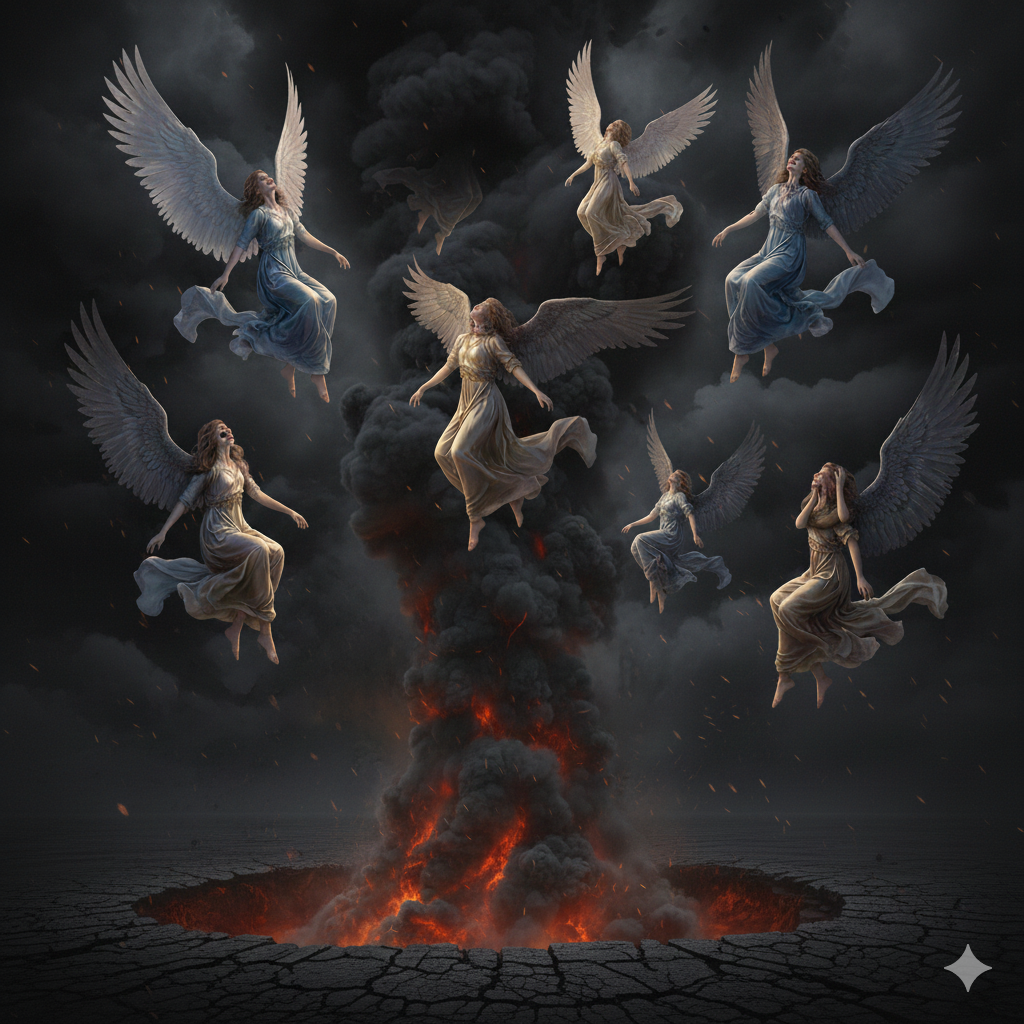
“With pleasure! You’re just way too full of yourself anyway!” And with that, the angel light bearer left the heavenly realms enshrouded in thick, coal-black, acrid smoke, taking a third of the heavenly hosts with him.
The angel choirs tried only partially successfully to carry on without their departed friends. A great void of unspeakable sadness almost completely engulfed the heavenly realms. Michael was appointed the new head angel in an attempt to restore some semblance of normal, but everyone in heaven had lost close friends to the rift, and none felt the loss more keenly than the Great Father.
And so, in deep thought, the Great Father spent many hours, studying the lights, both in the sky above as well as their reflection in the glassy sea below. And, as was often the case, Jesus the Son stood beside him, if only to offer a loving presence as comfort.
“You know, Son,” the Father finally said, “We created angels to do our bidding, but they serve us, not love us. We’ve created suns and stars and moons and planets, but none of these things are in our image. Nor can they be our friends. I want to create a being that has the choice of whether or not to love and serve us. I want to create a being that has our breath in their nostrils and our life in their spirit, who will fellowship with us and help us create something built on the love we share. I do not want to create an automaton. These creations must always know they have a choice, and they must always be aware there is an alternative, or there really is no choice at all. That little blue ball called earth looks like just the place to do it. What do you think?
“Of course you know they’ll choose wrongly.”
“I know. And I’m trying to figure out how to rescue them from their error when they do. We cannot have sin and rebellion in these holy walls. We threw angels out for just that reason, but I don’t want the same thing happening to these creatures, if only because they’ll each have a spark of the divine within them.”
“The wages of sin is death. If someone without sin chose to die in their place, would you consider it adequate payment?”
The father looked into his son’s eyes and noted with pleasure the steely determination shining there.
“It would not be easy, my Son. I couldn’t ask you to do such a thing.”
“As I recall, you didn’t.”
“You helped create the universe. You’d have to abandon your power, go there as a baby, dependent on your parents to feed and protect and nurture you. You’ll be liked by most only for what you can do for them, and when you can’t do anything, they’ll throw you out like garbage. You’ll be sick sometimes, you’ll hurt sometimes, you’ll have to feel everything they feel, get tempted in the ways they’re tempted, and still not sin. Then after all that, you’ll have to be put to death–and that death won’t be easy, as you’ll be a substitute for their sin, and you’ll be cursed.”
“He who hangs on a tree is cursed, right?”
The great Father nodded gravely.
“And then I’ll foresake you, so I won’t have to do it to them. Do you really think you can do all that?”
“That last will be the hardest,” Jesus admitted, a lump in his neck rising to prominence for some time before returning to normal. “But yes, I’ll do it.”
“You can back out at any time.”
“And then what will happen to them?”
The father looked off in the direction where Lucifer and his followers had exited.
“Exactly. Put it in place and I’ll do whatever and whenever you ask.”
Then let’s get on with the creation of humankind!” the Great Father said, beaming.
Dec. 14 is the 3rd Sunday of advent. The candle for this Sunday is called the joy candle, and, in some settings, the Shepherds’ Candle, because of the joy the shepherds felt on hearing the announcement of the birth of the Messiah. Rather than being purple or violet, it is sometimes pink, which is viewed by some to be a less solemn color than those other two colors, which traditionally represent royalty.
I’ve been asking myself a lot this week exactly what joy is. One conclusion I’ve come to is that, although many equate it with happiness, they aren’t the same. Happiness comes from something that happens to you, some external event, like getting a gift you wanted or winning the lottery. It’s no coincidence that “happiness” and “happen” share the same root.
Joy, on the other hand, doesn’t depend on circumstance. Indeed, the word is often uttered in the same or adjacent breaths in conjunction with things and events that are anything but joyful. Rather, it’s a feeling of peace, contentment, and knowing we belong.
David, in Psalm 51:12, which is a response to the prophet Nathan confronting him about his infidelity with Bathsheba, says,
“Restore to me the joy of your salvation and grant me a willing spirit, to sustain me.” Just a few verses later, he says:
17 My sacrifice, O God, is a broken and contrite heart you, God, will not despise.
And in Hebrews 12:2b, it says:
“For the joy set before him he endured the cross, scorning its shame, and sat down at the right hand of the throne of God.”
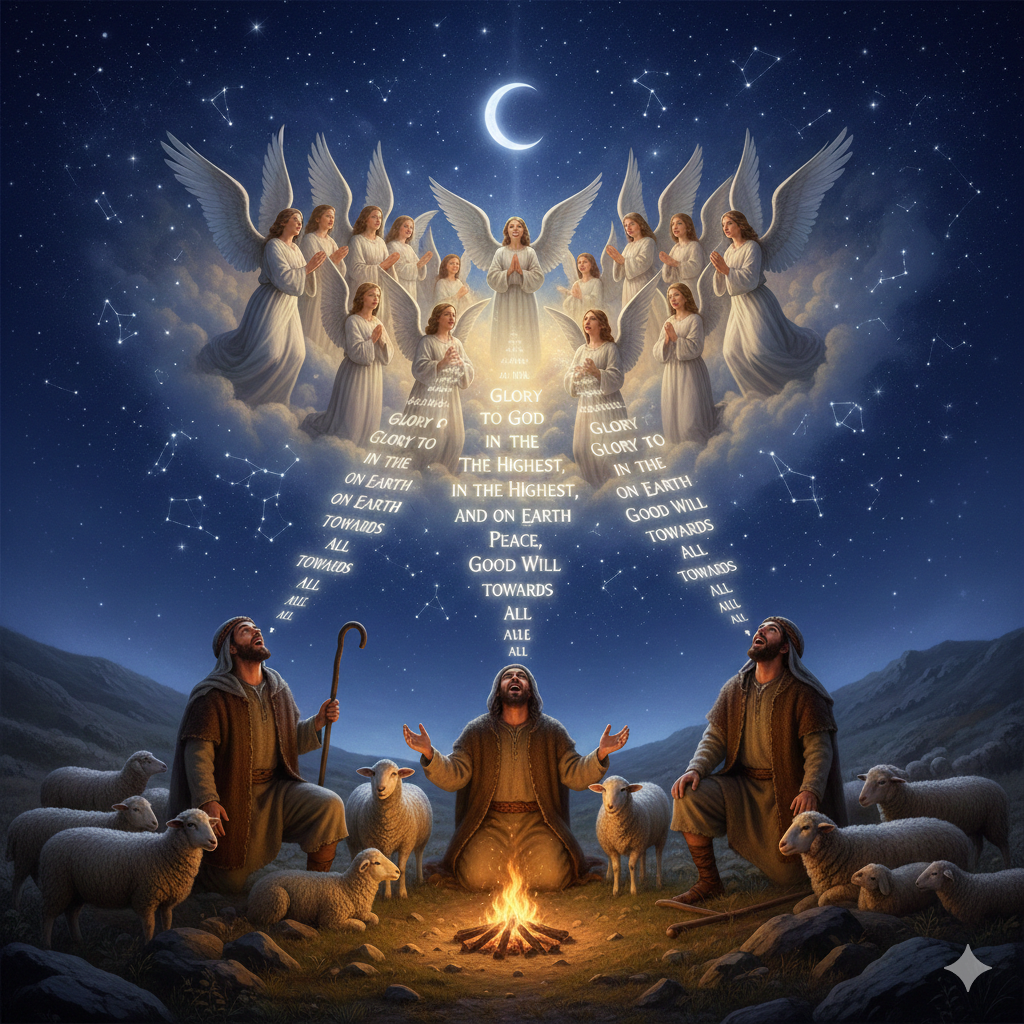
Joy endures despite circumstances. It’s given by God. Think of the shepherds who were told about the birth of Messiah before most others. We tend to think highly of shepherds today, but In Jesus’s time, they were scorned and looked down upon. They tended to smell like sheep, they tended not to be as clean, mostly because they lived outdoors–they were very much perceived like the “gypsies” of today. Yet they were the first to hear the angel choirs sing.
Joy endures because Jesus overcame the world, and with Him beside us, so can we. He made us His children, and nothing can separate us from His love (Romans 8:35-39).
During this advent season, we prepare to celebrate the birth of Messiah on Christmas day. But we also prepare our hearts for the time He’ll come again, and reunite all creation with Himself. We look forward to that time with great joy. And we also rejoice that our Messiah is with us now, even though invisible.
I am joining fellow author Lynda Lambert on her Sunday Blessings Blog Journey. Every Sunday we’ll be posting about a blessing in our lives. You can read her blog
This upcoming Sunday is the 2nd in the 4 Sundays of advent, and today we light the candle of peace. Peace is one of those blessings that’s really hard to define, but we know it when we see it, and even more when we feel it.
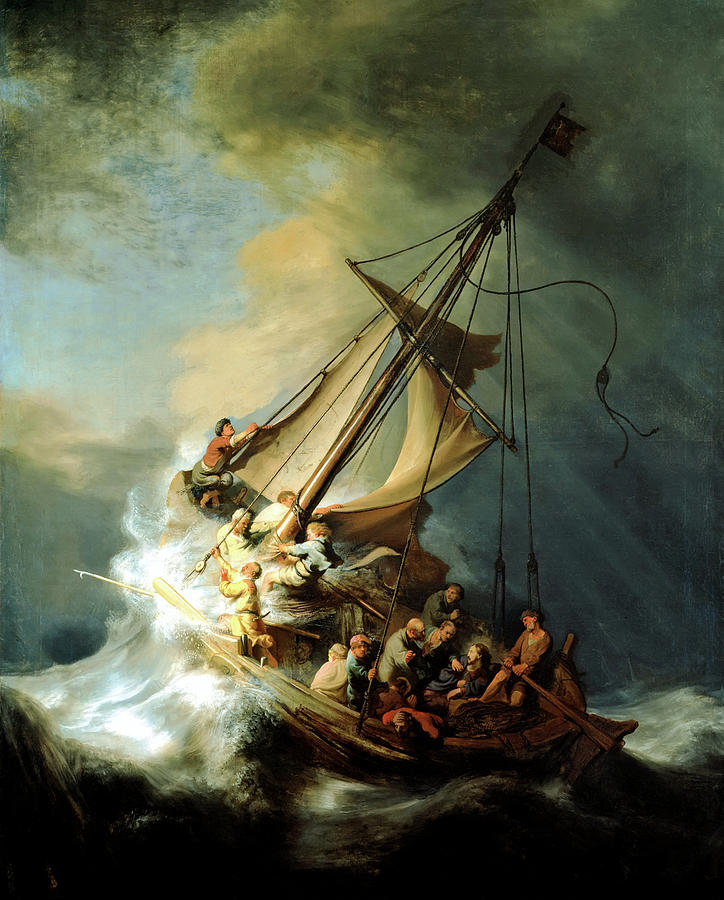
The image is of Rembrandt’s painting of Jesus calming the storm on Lake Gallilee. In 1 sense, there’s almost something commical about the whole scene. The disciples are struggling against the waves, likely screaming and soiling themselves and their boats because of the body’s very predictable responses to incredible fear and dread, while Jesus snores in the back of the boat, seemingly oblivious to the chaos around him. I would suggest he’d need to be sleeping extremely soundly, because these violent storms on the Sea of Gallilee are known to typically occur in winter, when the water temperature is about 68 degrees. I’ve gone swimming in Lake Michigan in the summer when the water temperature hovered around that, and folks, let me tell you, it was *cold!*
When someone finally manages to rouse him and asks whether he cares if they’re all killed, he simply gets up and utters “Peace, be still!” Mark 4:39, ESV. And the lakes throes ceased, replaced by a mirror-like quiet.
I’ve looked back over my life a number of times when my absolute worst fears never came true. I was all flustered and worried & in a dither, while Jesus sat back and said, “Girl, just cool it. I’ve got this!” He says it to us daily. “I’m in control, and don’t you or nature or illness or death ever forget it!” Sadly, the one most likely to forget it is me.
Here’s the first verse of a song I wrote about that scripture. If I can find the tape, I’ll put it up.
A small boat being swamped on the Lake of Gallilee The disciples struggling hard against the waves, And they woke Jesus saying, “Don’t you care if we are killed?” And he rose up and uttered, “Peace! Be still!”
“Peace be still, don’t you know I am ever in control And I guard each step that you trod. When the road of life’s dark, and it seems you’ve lost your way– Peace, be still, and know that I’m your God. Peace, be still, and know that I’m your God.”
Mark 4:35-41
I really appreciate Lynda telling me about her project, I appreciate her welcoming me to join her, and I wish you God’s peace throughout this holy season and throughout your lives the whole year long.